Voices from the Hollow: How Rural Podcasters Are Telling Their Own Stories
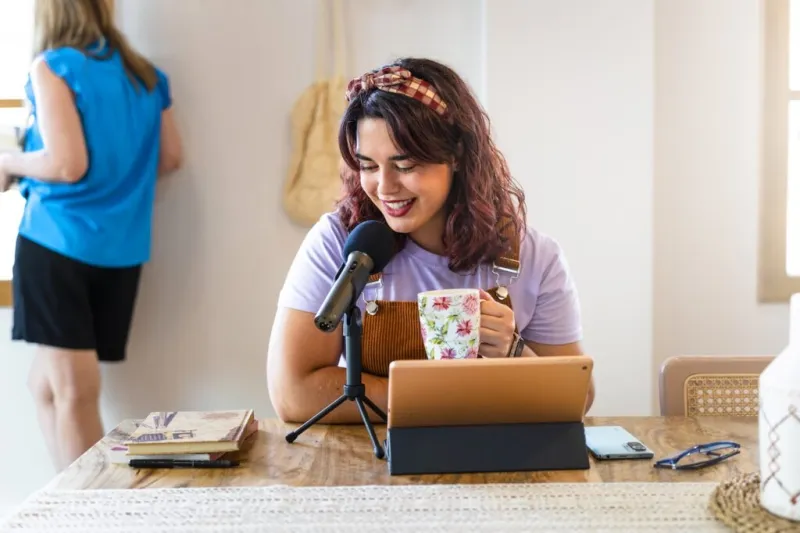
Photo: woman recording podcast in rural home kitchen with microphone, via www.lemonadestand.org
There's a creek outside Letcher County, Kentucky, that floods every spring. The old-timers know exactly which roads to avoid, which neighbors to check on, and which church hall doubles as a shelter. None of that knowledge has ever appeared in a newspaper. But it's been on a podcast.
Holler Talk, a community audio project based in eastern Kentucky's coalfields, has been recording exactly these kinds of stories for the past four years — the kind of institutional memory that lives in kitchens and front porches, not press releases. And it's one of dozens of grassroots audio projects quietly reshaping how rural Americans understand themselves.
The Gatekeepers Aren't Invited
For most of the 20th century, rural communities had a complicated relationship with media. Local newspapers covered high school football and county fairs. National outlets swooped in during floods, factory closures, or elections — and then left. The narrative was almost always written by someone from somewhere else.
Podcasting changed the math. All you need is a halfway decent microphone, a free account on a hosting platform, and something worth saying. That last part, it turns out, rural communities have in abundance.
"We're not waiting for NPR to discover us," says Marisol Fuentes, who runs El Camino Chico, a bilingual podcast out of the Rio Grande Valley in South Texas. "Our grandparents' stories, the way food connects us to Mexico, the way the land connects us to each other — that's not a niche interest. That's everything."
Fuentes started her show in 2021 after she couldn't find any audio content that reflected her community. She records episodes on a refurbished laptop in her aunt's kitchen. Her subscriber base has grown to over 8,000 listeners — most of them in the Valley, but a growing number scattered across the U.S. diaspora.
Community Radio's Second Wind
It's not just podcasts. Community radio stations — many of them low-power FM operations licensed through the FCC — are experiencing something of a renaissance in rural areas. These aren't the polished NPR affiliates you find in metro markets. They're scrappy, volunteer-run, and deeply local.
KWMT in Fort Dodge, Iowa, and WDBX in Carbondale, Illinois, are just two examples of stations that have leaned hard into hyperlocal programming — oral history projects, call-in shows in multiple languages, live coverage of community meetings that commercial stations wouldn't touch.
"We had a city council meeting about a proposed grain elevator expansion that was going to affect air quality in a low-income neighborhood," says Darnell Pitts, a volunteer programmer at a community station in rural Mississippi. "Nobody else covered it. We put it on air live, and people called in for two hours. That's what radio is supposed to do."
The Prometheus Radio Project, a Philadelphia-based nonprofit that's been advocating for community radio since the late '90s, has helped dozens of rural and tribal communities set up their own low-power stations over the past decade. Their work is a reminder that infrastructure matters — not just the content, but the physical ability to transmit.
Oral History as Resistance
Some of the most compelling rural audio work isn't framed as journalism or entertainment at all — it's preservation.
In the Mississippi Delta, a project called Deep Roots Radio has been recording interviews with blues musicians, sharecroppers' descendants, and civil rights veterans since 2019. The goal is explicitly archival: get these voices on tape before they're gone.
"There's a woman in Sunflower County who knew Fannie Lou Hamer personally," says the project's co-founder, a retired schoolteacher who asked to be identified only as Miss Cora. "She's 91. Nobody's coming to interview her. So we go to her."
The project has recorded over 300 hours of interviews, all of which are being donated to a local library's digital archive. Some episodes have been edited into a podcast series that's been used in high school classrooms across the state.
This kind of community-driven archiving represents something that commercial media structurally can't do — it's slow, it's relationship-dependent, and it doesn't scale. Which is exactly why it works.
The Tech Gap Is Real — But Shrinking
None of this is without obstacles. Rural broadband access remains a genuine barrier. Uploading large audio files on a satellite connection is, as one producer in rural Montana described it, "a spiritual exercise in patience." Equipment costs, even at the low end, can be prohibitive for volunteer-run projects.
Organizations like the Rural Media Group and the Center for Rural Strategies have been working to close some of these gaps — offering equipment loans, training workshops, and grant funding specifically for community audio projects. The 2021 Infrastructure Investment and Jobs Act included significant broadband expansion funding, though implementation has been uneven.
Still, the barriers are lower than they've ever been. And the appetite — for stories that actually reflect people's lives, told in their own voices — isn't going anywhere.
What Gets Lost When Stories Stay Untold
There's a practical argument for rural audio storytelling: it preserves knowledge. There's a cultural argument: it builds identity and pride. But there's also a political argument that's worth naming plainly.
When communities don't control their own narratives, someone else fills the vacuum — and that someone else rarely has their interests at heart. Rural America has been caricatured, pitied, and exploited in equal measure by media outlets that parachute in with preformed conclusions. Community audio is, among other things, a corrective.
"People hear 'rural' and they think they already know the story," says Fuentes. "They don't. They've never heard it. We're the ones who have to tell it."
At Cultural Commons, we believe that's exactly right. The podcast revolution happening in hollows and river deltas and high plains isn't just a media trend — it's communities asserting their right to exist on their own terms. That's worth listening to.