Curtain Call for Connection: Small-Town Theater Is Saving More Than Just the Show
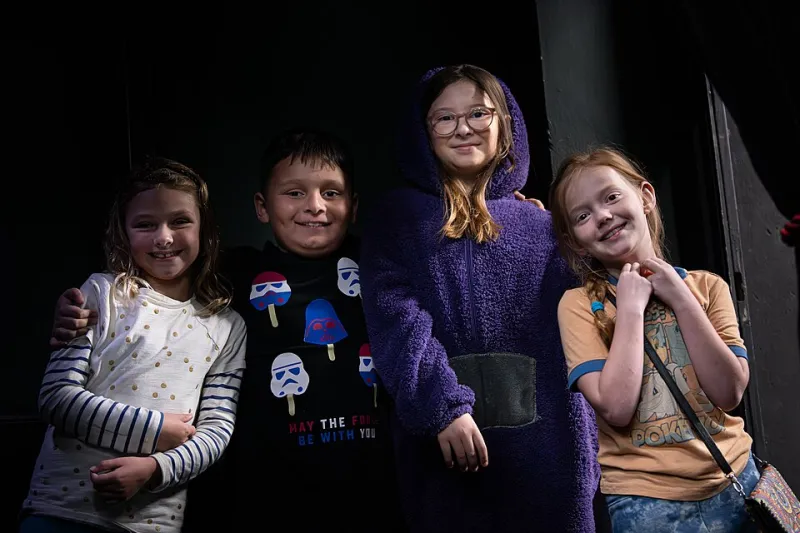
Photo: Sgt. 1st Class Alexander Henninger, Public domain, via Wikimedia Commons
The Galesburg Civic Theatre in Galesburg, Illinois doesn't have a fly system, a professional lighting grid, or a budget that would impress anyone in Chicago. What it has is a waiting list for auditions, a volunteer crew of 40 people ranging in age from 14 to 78, and a run of Mamma Mia! that sold out three weekends in a row last spring.
That's not unusual anymore. Across mid-sized American towns, community theater is experiencing something that feels less like a trend and more like a reckoning — a collective exhale after years of isolation, a rediscovery of what it means to make something together in a room full of people who are genuinely glad to be there.
This is the story of that revival. And it's bigger than the stage.
The Silence, and What Came After
Let's be honest about what the pandemic did to live performance. It didn't just close theaters — it severed the social tissue that community theater had quietly been maintaining for decades. Rehearsal schedules that doubled as weekly social rituals. Cast parties that turned acquaintances into friends. Opening nights that gave whole towns something to talk about together.
When those things disappeared, a lot of people didn't fully realize what they'd lost until the absence started to hurt.
"I didn't think of myself as someone who needed theater," says Kevin Ostrowski, a high school history teacher in Muncie, Indiana who auditioned for a community production of The Full Monty in 2022 on a whim. "And then I was in rehearsal three nights a week and I realized — this is the most connected I've felt to other people in two years. It genuinely got me through."
Ostrowski's experience is echoed by mental health researchers who have been paying close attention. Participation in community arts activities — theater in particular, given its inherently collaborative and embodied nature — has been linked to reduced symptoms of depression and anxiety, improved sense of belonging, and stronger social networks. A 2023 study from the University of Florida found that adults who participated in community theater reported significantly higher scores on measures of social connectedness than a comparable control group.
For communities already grappling with what sociologists have taken to calling an "epidemic of loneliness," that's not a trivial finding.
Downtown's Secret Weapon
The benefits aren't only personal. In towns where downtown districts have been hollowed out by economic shifts and the gravitational pull of big-box retail, a thriving community theater can function as genuine civic infrastructure.
In Decorah, Iowa — a small city of about 7,500 in the northeastern corner of the state — the Oneota Community Theater has become a linchpin of downtown revitalization efforts. Performances reliably fill restaurants before curtain and bars after, and the theater's renovation of a long-vacant storefront building created a visible anchor that local business owners say shifted the energy of the block.
"When people see a building lit up and full of people, it changes what they think is possible for a place," says Decorah's Main Street program director. "It's not just economic — it's psychological. It says this place is alive."
This pattern is playing out in city after city. Local theaters often operate with modest budgets, but their economic ripple effect — in dining, hospitality, and downtown foot traffic — consistently outpaces their direct spending. A study by Americans for the Arts estimated that nonprofit arts organizations generate roughly $27 in additional local economic activity for every $1 they spend. Community theaters, even the scrappiest ones, are part of that equation.
Who's Actually Showing Up
One of the more surprising dimensions of this revival is who's walking through the stage door. Community theater has historically skewed toward a particular demographic — middle-aged, white, middle-class — and that reputation has kept plenty of people from ever considering participation.
But in many communities, that's changing, and the change is deliberate.
The Mosaic Theatre Project in Fayetteville, Arkansas made an explicit commitment in 2021 to expand its outreach into communities that had historically felt unwelcome in theater spaces. They partnered with Spanish-language radio stations, held informational nights at a local mosque, and offered free childcare during rehearsals — a logistical barrier that had quietly excluded working parents for years.
The result: their 2023 production of In the Heights featured a cast that actually looked like Fayetteville's population. "It sounds obvious," says artistic director Tamara Whitfield, "but for a lot of people in our cast, it was the first time they'd seen their culture represented on a stage in this town. That matters enormously."
Inclusion isn't just a feel-good goal — it makes the art better. Productions that reflect the full range of a community's stories and faces tend to draw broader audiences, generate more word-of-mouth enthusiasm, and create the kind of authentic emotional resonance that keeps people coming back.
The Amateur Question
There's a word that makes some community theater folks bristle: amateur. It carries connotations of lesser-than, of almost-but-not-quite, of something you apologize for before you recommend it.
But the word's actual Latin root — amare, to love — tells a different story. Amateur theater is theater made by people who love it, not people who are paid for it. And that love, visible in every overcrowded rehearsal and hand-sewn costume and nervously delivered opening-night monologue, is precisely what makes it meaningful.
"Professional theater can be extraordinary," says Dr. Linh Nguyen, a theater studies scholar at Ohio State University who has been researching community performance. "But it can't do what community theater does, which is put your neighbor on stage. When you watch someone you know transform into a character, something shifts in how you see them — and how you see yourself."
That shift, multiplied across hundreds of productions in hundreds of towns, adds up to something culturally significant: a living, breathing argument that art isn't something that happens to communities. It's something communities do.
Keeping the Lights On
For all its momentum, community theater faces real structural challenges. Aging facilities need capital investment. Competition for volunteers' time is fierce. Ticket prices have to stay accessible while costs creep upward.
The organizations navigating this most successfully tend to be the ones that have stopped thinking of themselves purely as theater companies and started thinking of themselves as community hubs. They host comedy nights, film screenings, community forums, and youth workshops. They make their spaces available for other organizations. They become, in the truest sense, cultural commons — shared ground where the community comes to gather, create, and recognize itself.
That's a big job for a group of people who mostly just love putting on a show. But then again, love has always been a pretty powerful motivator.
The curtain is going back up. And if you listen carefully, you can hear a whole community exhaling.