Walls That Talk Back: How Community Murals Are Becoming the Neighborhood's Most Honest Mirror
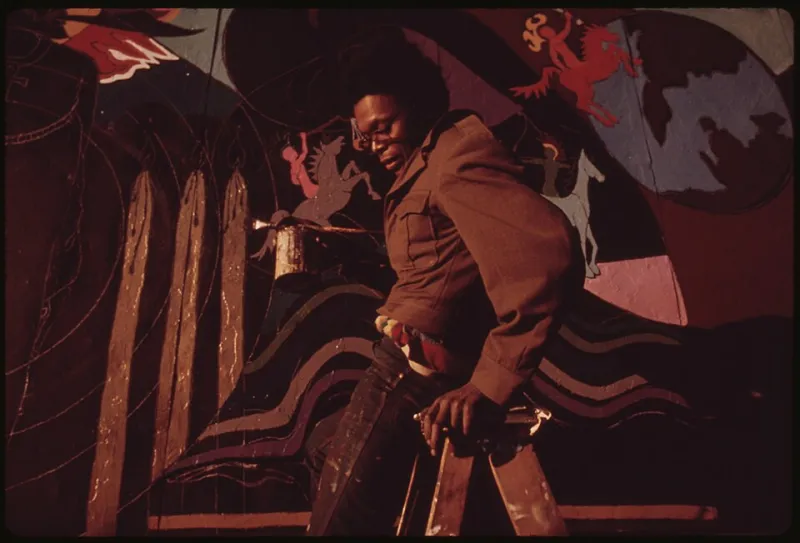
Photo: John H. White, Public domain, via Wikimedia Commons
There's a particular kind of invisibility that comes with living in a neighborhood that institutions tend to overlook. The murals on the walls, if there are any, were probably painted by someone from somewhere else, funded by a grant that required a certain aesthetic, approved by a committee that didn't include anyone who actually lives on the block. The result is art that exists in a community without really being of it.
But across the country, that dynamic is changing — slowly, imperfectly, and with a lot of community meetings — in ways that are worth paying attention to.
A Wall Is Never Just a Wall
Public art has always carried political weight, whether its creators intended it to or not. A mural of a founding father in a neighborhood where residents are fighting displacement isn't neutral. A generic "unity" mural that doesn't reflect the specific cultural heritage of the people who live there isn't neutral either. Every choice about what goes on a wall — who painted it, who commissioned it, who was consulted, whose face appears — is a statement about who belongs in a place and whose story is worth telling.
Community-led mural initiatives start from the premise that residents should be the ones making those choices. Not as a nice-to-have, but as the entire point of the project.
The process typically looks something like this: an organizing group — sometimes a neighborhood association, sometimes a cultural nonprofit, sometimes just a motivated cluster of residents — identifies a wall and secures permission from the property owner. Then comes the part that takes the longest and matters the most: actually asking people what they want to see.
Those conversations can get complicated fast. What does a neighborhood's history look like when that history includes both resilience and trauma? How do you represent a community that's genuinely diverse — multiple ethnicities, multiple generations, multiple relationships to the place — without flattening everyone into a symbol? And who gets to make those calls?
The Artist as Facilitator
The most successful community mural projects tend to involve artists who are willing to think of themselves less as singular creative visionaries and more as skilled facilitators of collective imagination.
That's a different skill set than most art school training prepares people for. It requires listening more than pitching. It means being willing to set aside your own aesthetic preferences when the community has something specific in mind. It means showing up to the neighborhood meeting even when attendance is low, and coming back the next month when it's better.
Local artists — people who grew up in the neighborhood or have deep roots there — often have a natural advantage in this role. They already understand the references, the history, the inside jokes and the open wounds. They know which corner was important and why. That embedded knowledge produces murals that feel genuinely different from the kind of public art that gets parachuted in from outside.
Some collectives are formalizing this by building apprenticeship components into their mural projects, pairing established muralists with younger artists from the community who can learn the technical craft while also shaping the creative direction. The wall becomes a classroom. The classroom becomes a community asset.
Reclaiming History, One Block at a Time
Some of the most powerful community mural projects happening right now are explicitly about historical reclamation — making visible the people, events, and legacies that official history has tended to erase.
In neighborhoods that have seen significant demographic change, murals can serve as a form of cultural memory. They say: people were here before you, they built something real, and that matters. For longtime residents navigating gentrification, seeing their grandparents' generation honored on a wall in their own neighborhood can be a profound act of recognition.
For Indigenous communities in urban areas, murals have become a way of asserting presence and sovereignty in spaces where Native history is routinely rendered invisible. For Black neighborhoods, they've been sites of tribute to local heroes who never made it into the textbooks. For immigrant communities, they've offered a way to bring the visual culture of home countries into American public space without having to ask anyone's permission.
This isn't nostalgia for its own sake. It's about establishing that a community has a history worth preserving — which is also an argument for why that community deserves investment, protection, and a seat at the table when decisions get made about its future.
When the Process Is the Point
Here's something that doesn't get talked about enough: for a lot of community mural projects, the finished painting is almost secondary to what happened in the process of making it.
The town halls where residents argued about what mattered most. The workshops where kids learned to handle a brush. The conversations between longtime homeowners and newer renters who had never actually spoken before. The moment when someone who'd been skeptical about the whole thing showed up to help paint a section and ended up staying for six hours.
Public art created through genuine community process builds social infrastructure that outlasts the mural itself. People who worked on a project together have a relationship. They know each other's names. They've navigated disagreement and arrived somewhere together. That's not nothing — in a lot of neighborhoods, it's everything.
The Funding Question
Let's be honest about the structural reality: community-driven public art is chronically underfunded, and the funding that does exist often comes with strings attached.
City arts grants frequently require professional artist credentials, detailed project plans, and reporting requirements that are difficult for grassroots groups to navigate. Corporate sponsorships can compromise creative independence. Even well-intentioned nonprofit funders sometimes have their own aesthetic or thematic preferences that shape what gets made.
Organizations that have figured out how to do this sustainably tend to combine multiple small funding sources, build relationships with local businesses that have an actual stake in the neighborhood, and structure their projects so that community labor is recognized and compensated rather than assumed to be free.
Paying local artists fair rates is non-negotiable if you want the work to be good and the relationships to last. It's also a statement about the value of creative labor in communities where that labor is often taken for granted.
The Commons on the Wall
A mural made by and for a community is a commons in the most literal sense — something created collectively, owned by no one and everyone, existing in public space for anyone to encounter.
When it works, it's one of the most democratic art forms we have. You don't need a ticket. You don't need to know the right people. You just have to live there, or walk by, or look up.
And when the faces on the wall look like the people walking past them, when the history depicted is the actual history of the actual place, when the colors and symbols and references come from inside the community rather than being imposed from outside — that's when a wall stops being a surface and starts being a conversation.
One that the neighborhood has been waiting a long time to have.