Raise Your Voice: The Community Choir Movement Turning Strangers Into Family
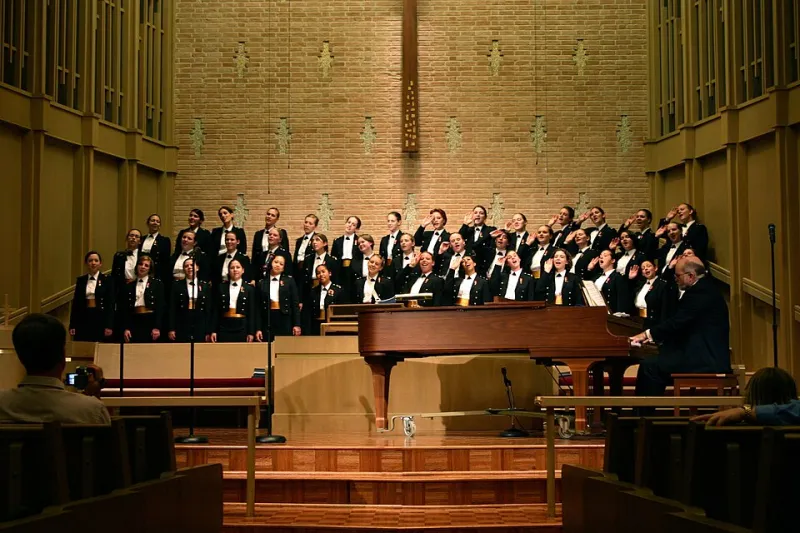
Photo: U.S. Navy photo by Journalist 1st Class Bill Kerstetter, Public domain, via Wikimedia Commons
The first time Gwendolyn Torres walked into a community choir rehearsal in Albuquerque, she almost turned around at the door. She hadn't sung since middle school. She was convinced she was tone-deaf. She'd only come because her neighbor had begged her for three weeks straight.
That was four years ago. Now she's a section leader.
"I came for my neighbor," she laughs. "I stayed because I didn't know I needed it this badly."
Gwendolyn's story is becoming increasingly common across the United States, where a growing wave of inclusive, no-audition community choirs is pulling in people who never thought of themselves as singers — and giving them something they didn't know they were missing.
Not Your Grandma's Church Choir
Let's be clear about what we're talking about here, because "community choir" can conjure some pretty specific images. We're not talking about polished ensembles performing Handel in a concert hall. We're not talking about competitive show choirs or church groups with strict membership requirements.
The choirs driving this movement are something different. They're multigenerational, often multicultural, and deliberately structured around participation rather than performance. Many don't require auditions at all. Some meet in parks or community centers instead of formal venues. A few don't even use sheet music.
What they share is a philosophy: singing together is a human right, not a privilege reserved for people with "good" voices.
Choir directors like Terrence Okafor, who runs the People's Harmony Collective in Cleveland, are building their programs explicitly around that idea. "The moment you tell someone they have to prove they're good enough to sing with other people, you've already lost the plot," he says. "Singing in community is as old as humanity. We're just trying to get back to that."
The Science of Singing Together
Here's the thing: the warm, connected feeling people describe after choir rehearsal isn't just vibes. There's legitimate research behind it.
Group singing has been shown to synchronize breathing patterns among participants, which triggers a relaxation response in the nervous system. It releases oxytocin — the bonding hormone — in ways that solo singing doesn't. Studies have linked regular participation in group singing to reduced feelings of loneliness, lower rates of depression, and even stronger immune function.
For communities dealing with high rates of social isolation — which, after the pandemic years, is basically everywhere — those benefits are significant. Choir isn't just entertainment. It's medicine.
"I've watched people come in visibly anxious and leave lighter," says Okafor. "Every single week. You can see it in their bodies."
This is especially meaningful in neighborhoods where access to mental health resources is limited. Community choirs offer something that therapy waitlists and expensive wellness programs can't always provide: a free, recurring space where showing up is enough.
Building Bridges Across Difference
One of the most striking things about the community choir movement is who it brings together. In a cultural moment defined by division and sorting — by algorithm, by neighborhood, by income bracket — these choirs are quietly doing something radical. They're putting people in the same room who would otherwise never interact.
The Harmony House Choir in Nashville draws retirees, college students, recent immigrants, and longtime residents to the same Thursday night rehearsal. They sing gospel, folk, West African songs, and pop standards. Nobody has to leave their identity at the door.
"We had a 70-year-old Appalachian woman and a 25-year-old woman from Senegal singing a duet together last spring," says choir director Priya Mehta. "They'd never met before joining us. Now they carpool."
That kind of connection — informal, sustained, built through shared experience rather than structured dialogue — is exactly what social scientists mean when they talk about bridging capital. It's the stuff that makes communities more resilient, more cohesive, more capable of working through hard things together.
Low Barrier, High Impact
Part of what makes inclusive community choirs work is how deliberately they lower the threshold for participation. No audition. No fee (or a very small suggested donation). No expectation that you'll know the words on the first try.
Many of these groups use a technique called "learning by ear," where songs are taught through repetition and call-and-response rather than notation. This makes the experience accessible to people with no musical background — and, importantly, it mirrors oral traditions from African, Indigenous, and many immigrant communities where music has always been passed down through listening rather than reading.
"Sheet music is a gatekeeper," says Marcus Webb, who leads the Open Chorus Project in Portland, Oregon, which specifically recruits people who've been told they can't sing. "When you learn by ear, everyone is on the same level from the start. Nobody gets to hide behind the page."
More Than a Rehearsal
Ask choir members what keeps them coming back, and most of them don't lead with the music. They lead with the people.
The potlucks before rehearsal. The group text that's somehow become a lifeline. The way someone always knows when you're having a rough week without you having to say so. The choirs that are thriving aren't just musical organizations — they're communities of care that happen to express themselves through song.
Gwendolyn Torres puts it simply: "My choir is probably fifteen people I would never have met otherwise. Now they're some of the most important people in my life. That happened because we were all willing to sound a little bad together at first."
That willingness — to be imperfect, to be present, to show up and try — turns out to be a pretty good foundation for almost anything. Including a community.
If there's a choir near you that'll take you as you are, off-key and uncertain and all: go. You can always leave. But you probably won't want to.