Pass the Mic with the Mole: How Restaurants Are Becoming Radical Cultural Spaces
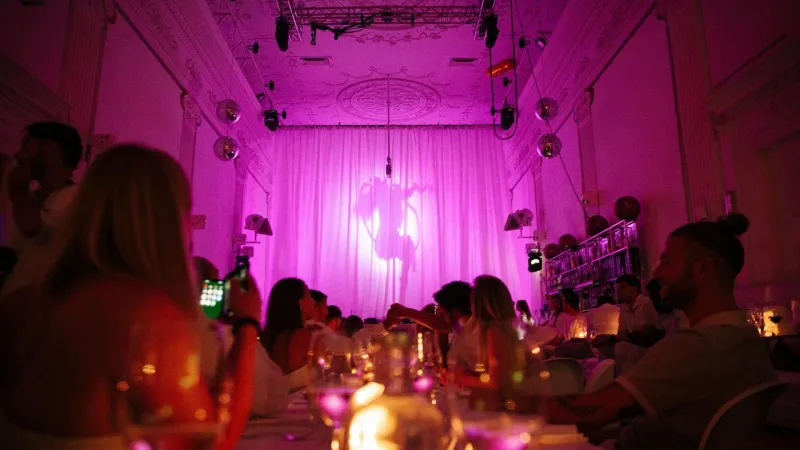
Photo: intimate pop-up dinner event with performance stage in restaurant diverse audience, via supper.nl
The tamales came out first. Then the poetry.
At a pop-up dinner in Chicago's Pilsen neighborhood last November, about forty people crowded into a Mexican bakery after closing time — folding chairs arranged in uneven rows, a single spotlight rigged to a pipe above the prep counter. For three hours, they ate, they listened, and somewhere between the second course and the spoken word set, a few of them cried.
That's the design.
"Food opens something in people," says Lucia Vargas, one of the organizers behind Mesa y Micrófono, the collective that put the event together. "When you're eating something your grandmother made, your defenses come down. That's when real conversation can happen."
A Stage Between the Tables
What Vargas and her collaborators are doing has a growing number of counterparts across the U.S. — from a queer supper club in New Orleans that stages original theatrical pieces between courses, to a Somali restaurant in Minneapolis that hosts monthly storytelling nights rooted in oral tradition, to a Vietnamese family-run spot in Houston that's become an unofficial gallery for Southeast Asian American visual artists.
These aren't dinner theaters in the classic sense — no murder mystery scripts, no show tunes. The performances are original, often politically charged, and almost always community-generated. The venues are intimate by necessity, which turns out to be a feature, not a bug.
"You can't be passive in a room that size," says Marcus Webb, a playwright and co-founder of Supper & Subtext, a Black queer performance collective in Atlanta. "You're three feet from the performer. You're sharing a meal with strangers. That's already an act of trust."
Supper & Subtext hosts quarterly events at a soul food restaurant in the West End neighborhood. Tickets are priced on a sliding scale — $15 to $45 — and the restaurant donates a portion of food sales back to the collective. The performances have covered everything from housing displacement to chosen family to the particular grief of losing elders during the pandemic.
Heritage on the Menu
For immigrant communities especially, the restaurant-as-performance-space model carries a specific kind of weight. These are often the same communities that have watched their neighborhoods gentrify, their cultural institutions defunded, and their stories told badly — or not at all — by mainstream arts organizations.
When the performance happens inside a restaurant that's already a community anchor, the stakes feel different.
"This restaurant has been here for twenty-two years," says Hana Osman, whose family runs a Somali eatery in Minneapolis's Cedar-Riverside neighborhood. "People come here for weddings, for funerals, for everything. When we do storytelling nights, we're not bringing culture to the community. The culture is already here. We're just making space for it to be seen."
The storytelling nights at Osman's restaurant are intergenerational by design — elders share traditional oral narratives, younger community members respond with contemporary pieces, sometimes in English, sometimes in Somali, sometimes in a fluid mix of both. The result is something that no formal arts institution has quite managed to replicate.
Food plays a central role, and not just as backdrop. Dishes are chosen to correspond thematically with the evening's performances. A night focused on migration might feature recipes that trace the journey — Somali spiced rice alongside a dish that reflects the foods people found when they arrived in Minnesota winters. It's curatorial in the truest sense.
Making It Accessible (On Purpose)
One of the most consistent things about these events is a deliberate commitment to accessibility — not just in price, but in atmosphere.
Traditional performing arts spaces can be intimidating. There's a dress code expectation, a behavioral protocol, a whole set of unspoken rules that tend to favor people who grew up with arts education. A restaurant doesn't carry that freight.
"I've had people tell me they've never been to a 'show' before," says Webb. "But they come to dinner. They feel comfortable. And then something happens that moves them, and suddenly they're part of this thing they thought wasn't for them."
For LGBTQ+ collectives in particular, the intimacy and informality of restaurant settings creates safety that larger venues can't always guarantee. Queer Feast, a roving supper club operating out of New Orleans, specifically seeks out LGBTQ+-owned or allied restaurants for its monthly events, creating an environment where performers and audiences alike can show up fully.
"We've had grandmothers come to Queer Feast because their grandkid invited them," says the collective's founder, who goes by Sable. "And we've had those grandmothers come back on their own. That's intergenerational dialogue. That's not something you can manufacture — it has to grow from somewhere real."
The Economics of Radical Hospitality
Making this work financially is its own creative challenge. Most of these collectives operate on shoestring budgets, relying on sliding-scale ticket sales, small grants from local arts councils, and the generosity of restaurant owners who are often community members first and business operators second.
Some have found support through community foundations or municipal arts funding. Others have structured themselves as nonprofits to access philanthropic dollars. A few have built sustaining membership models where regular supporters pay a monthly amount to keep events free or low-cost for those who can't afford tickets.
None of it is easy. But the model has a certain resilience — because the infrastructure is borrowed rather than owned, the overhead is low, and the community investment is high.
What Happens When You Feed People and Tell Them the Truth
There's something almost ancient about the combination of food and storytelling. Humans have been doing this — gathering around shared meals to make sense of the world — for as long as there have been humans. What's new is the intentionality, the framing of these gatherings as cultural production, as art, as activism.
"We're not trying to be a theater company that happens to serve food," says Vargas. "We're trying to be a community that takes care of each other. The food is care. The performance is care. The conversation afterward is care."
At Cultural Commons, that framing resonates deeply. Culture isn't something that happens to communities — it's something communities make, together, in the spaces they already inhabit. Sometimes that space is a gallery or a concert hall. And sometimes it's a bakery in Pilsen, after closing time, with tamales and a single spotlight and forty people who needed to be in the same room.