Paint the Town: How DIY Art Collectives Are Handing Culture Back to the People
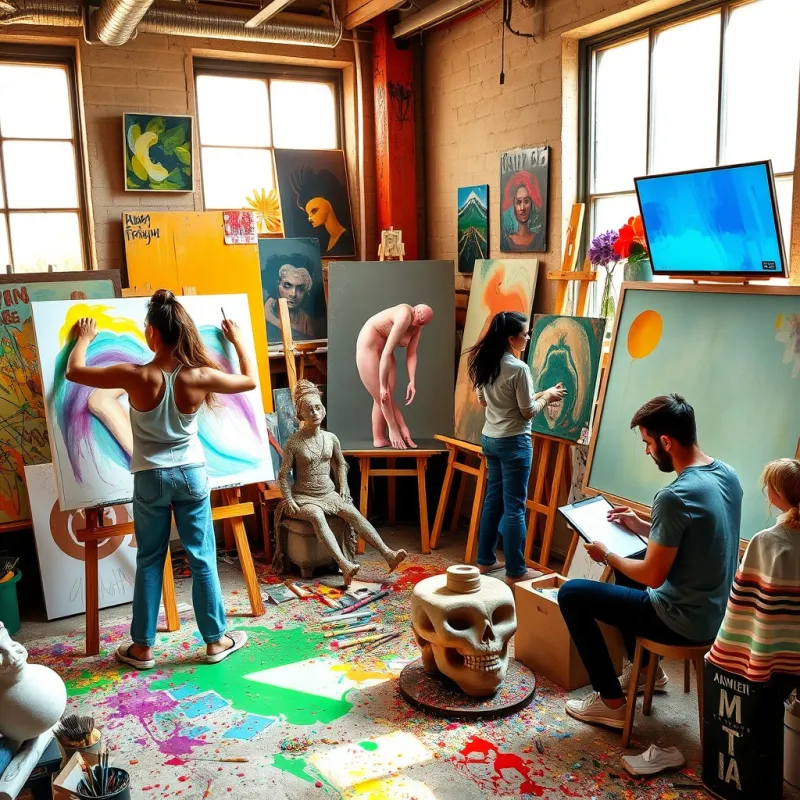
Photo: diverse community artists working together in creative studio space, via files.idyllic.app
There's a particular kind of magic that happens when a bunch of neighbors decide they're done waiting for someone else to bring art to their community. No grant committee approval, no board of directors, no velvet rope. Just people, materials, and a shared belief that creativity is a human right — not a luxury reserved for those with the right zip code or the right connections.
Across the United States, a quiet revolution is unfolding in repurposed warehouses, converted storefronts, and humble backyard studios. Independent artist collectives are doing what major cultural institutions have long promised but rarely delivered: making art genuinely accessible, genuinely representative, and genuinely alive.
We spent time with four of these grassroots spaces to understand what they're building — and why it matters so much right now.
The Eastside Maker Collective, Houston, TX
In Houston's historically underserved Fifth Ward neighborhood, the Eastside Maker Collective started in 2019 as a WhatsApp group of six muralists who were tired of watching developers slap up condos without a single nod to the community's visual history. Today, they operate out of a 2,400-square-foot converted auto shop that hosts printmaking workshops, open studio nights, and a sliding-scale gallery wall where local artists can exhibit without paying the fees that typically gatekeep gallery access.
"We kept hearing that the art world was 'diversifying,'" says co-founder Marisol Reyes, a third-generation Houstonian whose grandmother immigrated from Oaxaca. "But diversifying for who? The same institutions, the same price points, the same gatekeepers — just with a few more brown faces in the brochure."
The collective's model is radically simple: dues are paid in time, not money. Members contribute eight hours a month to collective operations — teaching, cleaning, grant writing, social media — and in return get free studio access, equipment use, and a community of peers. Last year, they facilitated over 300 free or low-cost workshop seats for Fifth Ward residents aged 8 to 72.
Rust Belt Art Lab, Youngstown, OH
Youngstown lost more than half its population between 1970 and 2010. What it didn't lose was its artists. The Rust Belt Art Lab, operating since 2021 out of a former furniture warehouse downtown, has become one of the most compelling examples of art as genuine community infrastructure.
Founded by a coalition of painters, musicians, and a retired steelworker-turned-ceramicist named Dale Hutchins, the Lab functions on a cooperative ownership model — every active member holds an equal stake in the space. That structure, unusual even in the DIY art world, means decisions about programming, membership, and finances are made democratically.
"When you own it together, you fight for it together," Hutchins says simply.
The Lab has partnered with local schools to offer after-school programming, and its monthly "Open Factory" events — free public art-making nights — routinely draw 80 to 120 people of wildly different ages and backgrounds. In a city where social isolation has been a documented public health concern, that kind of consistent gathering carries weight that goes far beyond aesthetics.
Queer Frequencies, Portland, OR
Not every collective works out of a physical space, and Queer Frequencies proves that community cultural production can thrive in distributed form. Based in Portland but operating largely online and through pop-up events, Queer Frequencies is a media and performance collective centering LGBTQ+ artists of color in the Pacific Northwest.
They produce a podcast, a zine published quarterly, and a rotating series of live performance showcases that have taken place in everything from a Black-owned bookstore to a community garden pavilion. The intentional refusal to anchor to a single venue is part of the point — they go to where their community already gathers.
"Institutions want you to come to them, on their terms, in their space," says co-organizer Juno Park. "We wanted to flip that. The culture is already here. We're just giving it a stage."
Queer Frequencies has also become a meaningful incubator for emerging artists who might otherwise struggle to find platforms that center their full identities. Several artists who got their first showcases through the collective have since been featured in regional publications and earned residencies at larger arts organizations.
La Raíz Cultural Center, Albuquerque, NM
In Albuquerque's South Valley, La Raíz ("The Root") operates as something between an art studio, a community archive, and a neighborhood living room. Founded in 2018 by a group of Chicana artists and cultural workers, the center focuses explicitly on preserving and evolving New Mexican artistic traditions — from santos carving to lowrider art to contemporary muralism — in ways that connect generations.
Elders teach. Young people document. Everyone eats. The communal meal at the end of each workshop session isn't incidental — it's structural. "Food is culture," says director Esperanza Morales. "You can't separate them."
La Raíz has become especially notable for its intergenerational oral history project, in which teen artists interview community elders about cultural memory and then translate those stories into visual art. The resulting works have been exhibited at a local library, a community health clinic, and the center itself.
What These Spaces Share — And Why It Matters
For all their differences in geography, medium, and community focus, these four collectives share a foundational commitment: culture should be made by and for the people who actually live somewhere, not handed down from institutions that are often physically, financially, and philosophically distant from everyday life.
They also share a pragmatic creativity when it comes to sustainability. None of them rely on a single funding stream. They mix small grants, community fundraisers, workshop fees on sliding scales, merchandise, and good old-fashioned mutual aid. It's scrappy, sometimes stressful, and entirely real.
What the mainstream art world is slowly waking up to — what these collectives have known all along — is that when you remove the barriers to participation, you don't get chaos. You get an explosion of creativity that reflects the actual depth and diversity of American life.
That's not a small thing. At a moment when so many communities feel fractured and unseen, spaces where people can make something together, tell their own stories, and see themselves reflected in the culture around them are doing something genuinely essential.
The garage, it turns out, might be exactly the right place to start.