Two Left Feet, One Shared Floor: Why Americans Are Falling Back in Love With the Community Dance Hall
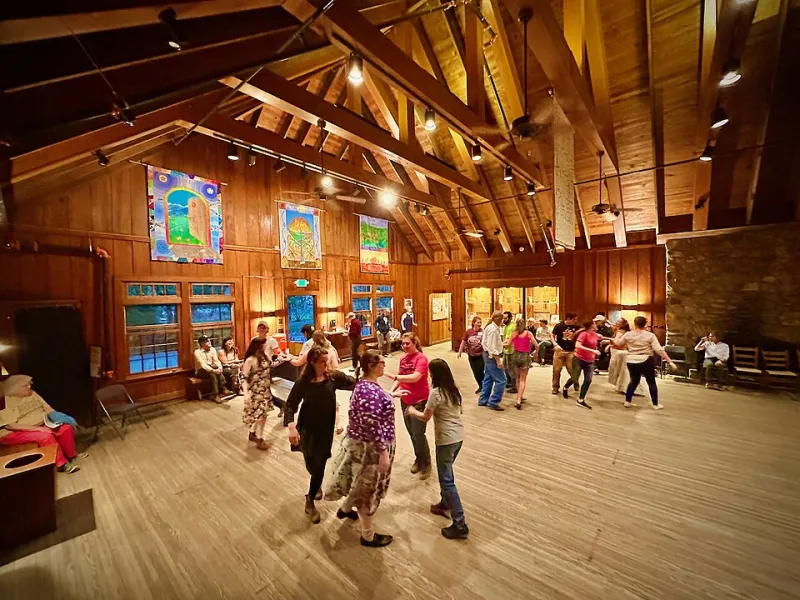
Photo: Harrison Keely, CC BY 4.0, via Wikimedia Commons
The Grange hall in Corinth, Vermont, doesn't look like much from the road — white clapboard, a steeple that leans a little, a sign out front advertising a pancake breakfast from two years ago. But on the first Saturday of every month, the parking lot overflows with Subarus and pickup trucks, and inside, a fiddler, a banjo player, and a caller are leading about eighty people through a contra dance that would have felt familiar to their great-grandparents.
Nobody's filming it. Nobody's going viral. And that's exactly the point.
The Hall Was Always the Point
Community dance halls used to be the beating heart of American social life. Farm bureaus, granges, Elks lodges, union halls, church basements — nearly every town had a room with a good floor and bad lighting where people gathered to swing, waltz, polka, and two-step their way through the week.
Then came television, then the suburbs, then everything else. The halls didn't disappear, exactly. They just went quiet.
What's happening now is a revival led less by nostalgia than by need. After years of screens, isolation, and algorithmic everything, people are hungry for something physical, local, and low-stakes. The dance hall — cheap, unglamorous, and open to anyone with ten bucks and shoes they can move in — delivers.
Meet the People Keeping the Floor Swept
The revival runs on volunteers, not venture capital. Take the crew behind the monthly salsa night in a church basement in Des Moines: a retired schoolteacher who handles the soundboard, a bartender who donates her tips to the snack fund, and a DJ named Marisol who learned to dance at her cousin's quinceañeras and now teaches a beginner lesson every night before the music really kicks off.
Or consider the contra dance circuit across New England and the Carolinas, where callers — part emcee, part choreographer, part stand-up comic — teach every move from the mic. No experience required. No partner required. The whole point is that you switch partners every few minutes, which means newcomers meet half the room before the night is over.
"It's the only social event I know where a 19-year-old college kid and a 78-year-old retired postal worker end up laughing together," says one longtime caller in Western Massachusetts. "You can't fake that. The dance does it for you."
Why In-Person Dancing Beats the Algorithm
There's a reason fitness apps keep trying to gamify dance and keep falling short: dancing with real people in a real room does something a screen can't. You make eye contact. You read a stranger's energy. You sweat, you stumble, you laugh at yourself in front of witnesses.
Researchers who study social connection have long pointed to synchronized movement — moving together in rhythm — as one of the fastest ways to build trust between strangers. Communities that dance together tend to show up for each other in other ways, too, from fundraisers to flood cleanups.
And unlike most entertainment, a community dance is participatory by design. There's no audience. There's no algorithm deciding who gets seen. If you show up, you're in the show.
Want to Start One in Your Town? A Starter Guide
The good news: you don't need a dance background. You need a floor, a sound source, and about six weeks of patience. Here's the short version:
- Find the room. Grange halls, VFW posts, senior centers, church basements, and library meeting rooms are often cheap or free for community events. Ask about floor quality — wood is ideal, concrete is a knee-killer.
- Pick a format people can learn in one night. Contra, line dancing, salsa, and cumbia all work because a teacher can get beginners moving within thirty minutes.
- Recruit a teacher or caller before you pick a date. Many cities have dance teachers who'll do community nights for a modest fee plus the joy of it. Folk dance federations and local universities are good places to ask.
- Price it for the neighborhood. Ten to fifteen dollars a head, with nobody turned away. Cover the band, cover the rent, break even.
- Make the first hour beginner-friendly. A lesson at the top of the night lowers the barrier for everyone who's nervous — which is everyone, the first time.
- Expect six people your first night. Then expect twelve the next. Community dance nights grow by word of mouth, not marketing. Give it a season.
The Floor Is Open
There's something quietly countercultural about a room full of people doing an old dance badly and happily, with phones in their pockets and their shoes by the door. It's entertainment that asks something of you — your presence, your attention, your willingness to look a little silly.
In Corinth, Vermont, the fiddler strikes up the last tune of the night, and the caller shouts one final figure. Strangers swing. Neighbors bow. Then the lights come up, chairs get stacked, and everyone walks out into the cold knowing they'll do it all again next month.
No algorithm required. Just a hall, a floor, and somebody willing to call the first dance.